

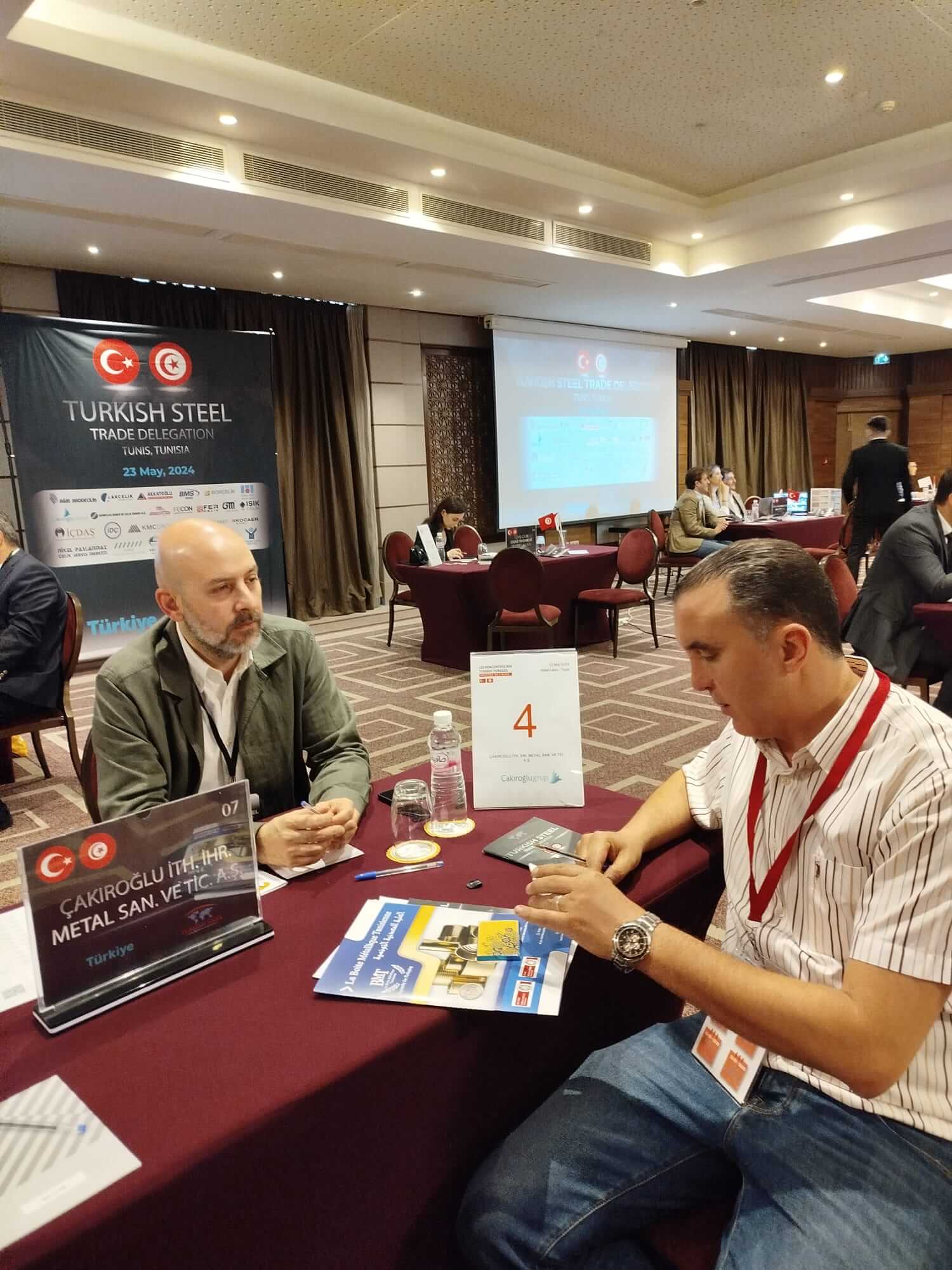
The Steel Exporters’ Association (ÇİB) organized the Tunisia Sectoral Trade Delegation program on 22-24 May 2024. As the third sectoral trade delegation of 2024, the event took place with the participation of 24 Turkish steel exporting firms. At the heart of the program were the B2B meetings held on 23 May 2024 at the Laico Tunis Spa & Conference Center, bringing Turkish exporters together with Tunisian importers.
The delegation aimed to strengthen the Turkish steel sector’s presence and trade volume in North Africa and to deepen ties with the Tunisian market. Following the decline seen in 2023 and early 2024, regaining momentum in this market formed the core motivation of the organization.
| Item | Detail |
|---|---|
| Event | Tunisia Sectoral Trade Delegation (3rd of 2024) |
| Date | 22-24 May 2024 |
| B2B day | 23 May 2024 |
| Venue | Laico Tunis Spa & Conference Center |
| Participants | 24 Turkish steel exporting firms |
| Organizer | Steel Exporters’ Association (ÇİB) |
Türkiye holds the position of a critical steel supplier for Tunisia. However, 2023 was a challenging year for bilateral trade. According to ÇİB data, Türkiye’s steel exports to Tunisia fell by 42% in volume in 2023; with the duty Tunisia began applying from January 2024, the decline ran at around 34% in the first four months of the year. Global inflation, rising input costs, and unfair trade measures were also external factors that deepened this contraction. This picture explains why the delegation gained importance during this period.
In total bilateral goods trade, Türkiye is by far the surplus-holding side:
| Year | Türkiye → Tunisia (million $) | Tunisia → Türkiye (million $) |
|---|---|---|
| 2021 | 1,376 | 267 |
| 2022 | 1,550 | 396 |
| 2023 | 1,248 | 293 |
Source: TİM Tunisia Country Brief (total goods trade; iron and steel is among Tunisia’s top 10 import categories). Because a steel-specific annual USD figure was not separately disclosed in the ÇİB release, the volume-based official statement (42% decline) is used on the steel side
Over the same period, Türkiye’s total steel exports fell from 19.58 million tons in 2022 to 14.52 million tons in 2023, and the country dropped to ninth place among the world’s largest steel exporters. Long products, followed by flat steel products, made up the bulk of these exports.
Tunisia is a market that imports production inputs rather than consumer goods. Iron and steel rank among the top of the country’s imports, making Tunisia a lasting buyer of construction and industrial-input steel. The country’s infrastructure investments, housing projects, and the manufacturing sector’s continuous raw-material needs carry this demand beyond one-off orders, turning it into a stable supply relationship. For this reason, the Tunisia Sectoral Trade Delegation should be read not merely as a short-term sales event, but as an effort to build an industrial partnership. Geographic proximity and the price-quality balance of Turkish steel give this partnership an advantage over competing suppliers. During the delegation period, it was stated that ministry-level talks aimed at removing the duty were also on the agenda.
As Çakıroğlu Metal, active in iron and steel trading and distribution since 1969, we closely follow the dynamics of production-input-driven markets such as North Africa. As organizations like the Tunisia Sectoral Trade Delegation highlight, success in these markets depends on supplying the right product, at the right time, without interruption. With our strong inventory management across long products, flat products, profiles, and steel mesh, we provide reliable supply not only across Türkiye’s 81 provinces but also to export markets.,
The Tunisia Sectoral Trade Delegation clearly demonstrated the Turkish steel sector’s determination to reinforce its position in North Africa following the decline seen in 2023 and early 2024. The B2B meetings attended by 24 firms did more than establish new commercial connections; they also created common ground for preserving existing relationships and for overcoming the duty barriers introduced in January 2024. Tunisia’s structure as a market that imports production inputs rather than consumer goods keeps steel demand relatively independent of cyclical fluctuations, making it a permanent axis. This, in turn, keeps the market valuable over the medium and long term for firms that operate with the right product range, competitive pricing, and above all a disciplined, uninterrupted supply. The conclusion of the ministry-level talks on the duty process will be the key factor determining to what extent this potential is realized in the period ahead.
News Source

29.May.2024


